Personal Feedback: MRF Visit penned by Louise Kinrade
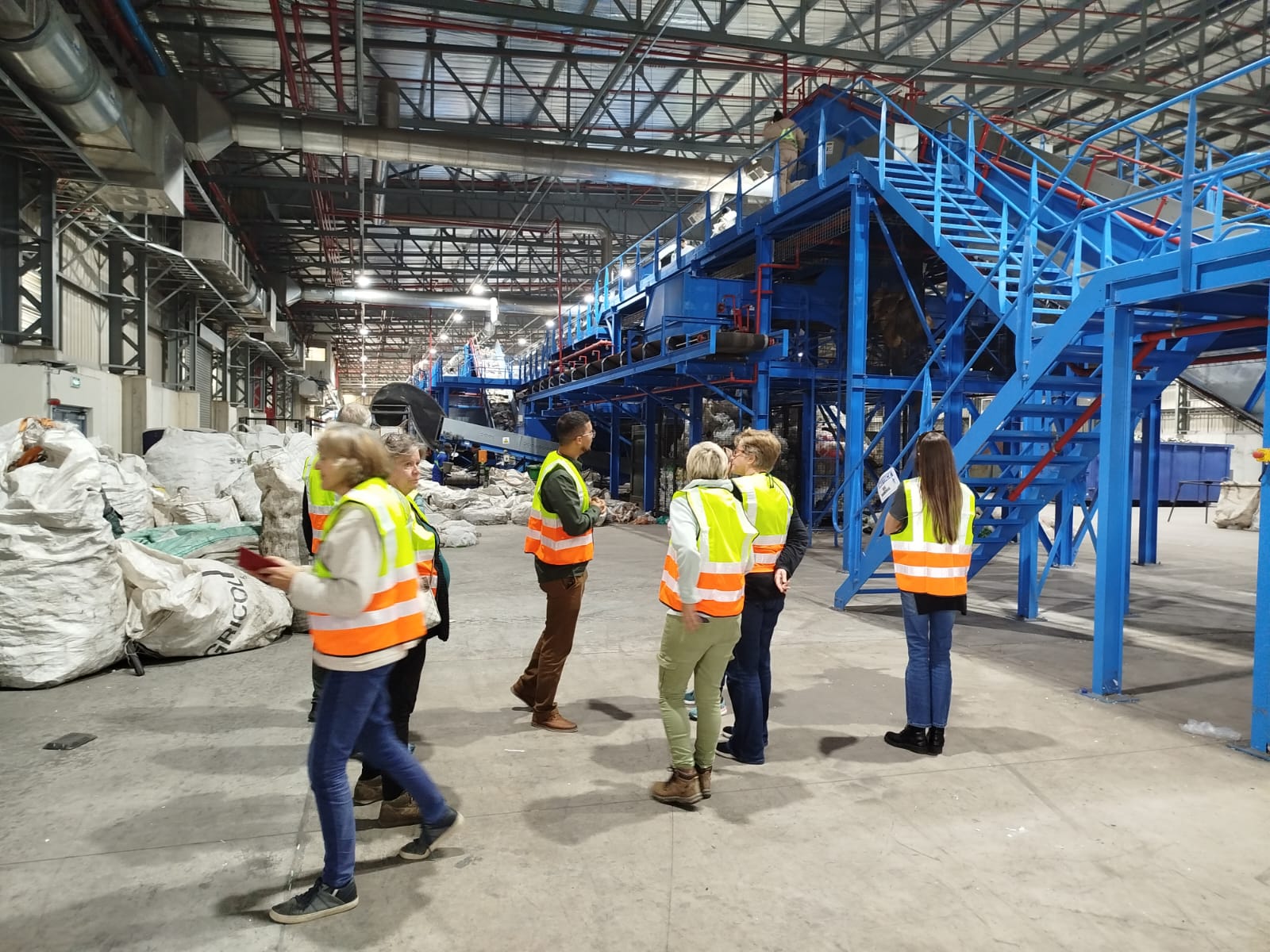
Councillor Carolynne Franklin recently booked a community site visit to the Coastal Park Materials Recovery Facility (MRF) off Baden Powell Drive, Muizenberg, and invited all representatives from Ward 71’s ratepayer associations, as well as interested residents to participate in this informative and educational tour.
On arrival, we were greeted by Maurice van Blommestein, a City of Cape Town official based at the MRF, who checked us in and escorted us up to a meeting room for an official ‘meet and greet’.
All visitors to the MRF are required to watch a health and safety video before entering the operational area, which was followed by Maurice sharing stats and data information relating to the City’s waste management strategy, the 3 city-wide recycling facilities (Muizenberg, Bellville, and Vissershoek), as well as specifics on Muizenberg’s structure, capacity, and operational activities.
Background information on Muizenberg’s MRF
The City opened this R434 million facility in early 2025 in Muizenberg, behind the dunes off Baden Powell Drive. It is located alongside the current landfill site with the aim of diverting recyclable material from landfill back to the source manufacturers to recycle into new products.
It is an imposing building that belies a state-of-the-art reclamation operation powered solely by the transfer of methane gas, collected from the landfill, and channelled via an underground piping network to turbines to be processed into electricity. This power generation operation in 2025 enabled the City to earn R36 million from selling (off-setting) of carbon credits to corporate South Africa.
The Muizenberg MRF operation, once at full capacity, will process up to 70 tonnes of recyclable material per day – it is currently processing around 25 to 30 tonnes per day – and employ about 160 people from the local neighbourhoods. Currently, the core work team is in training, but as volumes increase, the operation will gear up labour-wise and operationally. The Belville operation, which has been in operation for a longer period, has a larger and more experienced work team that processes some 55 tonnes daily.
The current landfill site at Muizenberg is near its permitted aerial height and volume capacity. In the next year, it will be closed, and a new site will be opened. This, however, will not affect the reclamation operation.
The reclamation operation
The Muizenberg facility receives its recycling material from a door-to-door truck collection undertaken by two operators contracted to the City of Cape Town. Within Kirstenhof and surrounds, the contractor is WasteMart. The transparent collection bags contain clean but unsorted plastics, paper, cardboard, glass, and metals.
The bags are offloaded in the entrance to the processing facility – an extremely large warehouse structure – where a forklift operator scoops them up into a large blue bin. This is the bag splitter unit comprising rotating blades that rip open the collection bags, allowing the contents to drop down onto the conveyor belt.
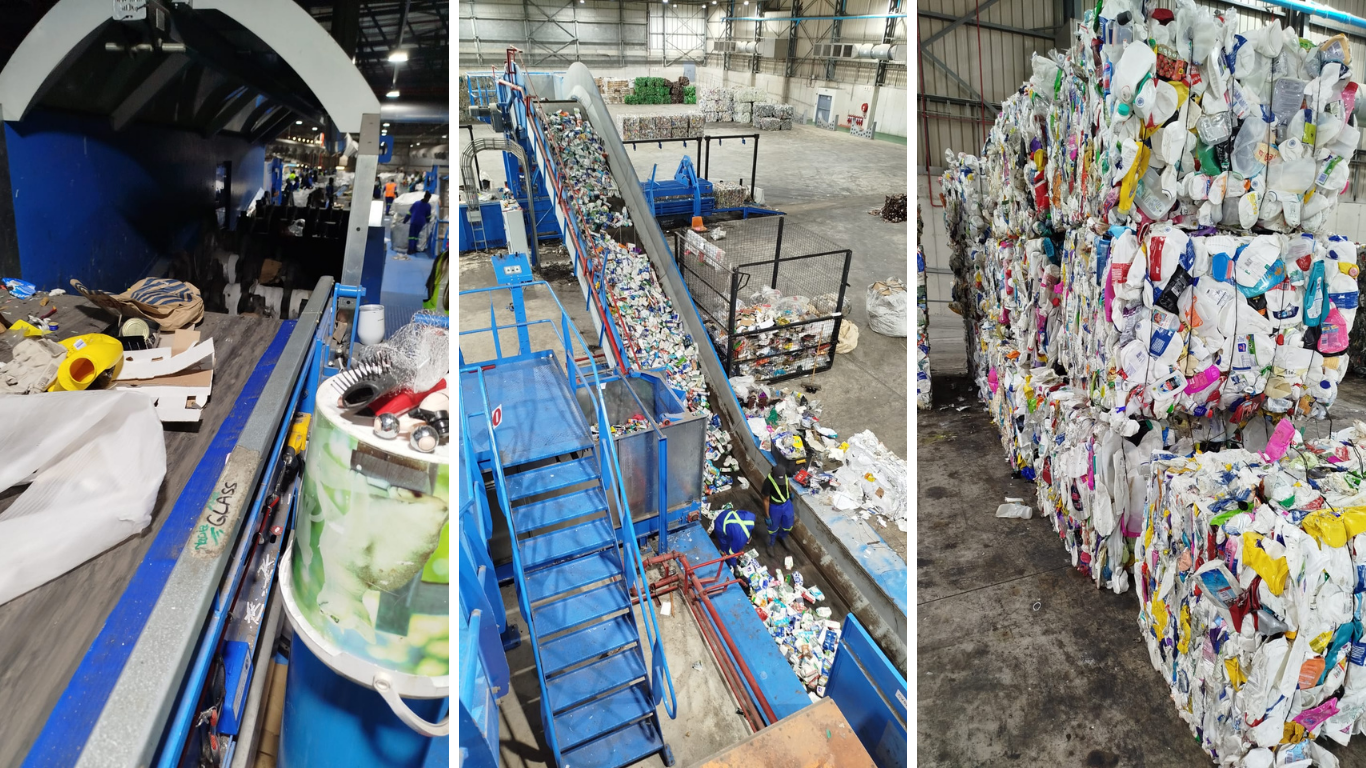
The conveyor feeds into the next sorting unit where some 10 rows of rotating wheels tumble the content towards the sorting conveyor belts. At this point, heavy material, like glass, drops down a chute to ground level, where 2 pickers sort the various glass into large white collection bags for the glass reclamation industry.
While the glass drops away, the rest of the material is channelled onto two conveyor belts operating side by side on an elevated platform. There are teams of two pickers placed on either side of each belt who are tasked to handle only one item of material. The first 2-person team removes all the shredded collection bags and any plastic bags and wrapping, dropping these down a chute at their side into large white collection bags below. The next team of pickers removes any glass bottles, pill bottles, etc., dropping these down the chutes at their side. The next few teams remove paper, books, and magazines, depositing these in the large white bags stacked around them.
The conveyor belt moves very slowly to not overwhelm the pickers while they are developing their picking skills, speed, and capacity. At the end of the conveyor process, the non-recyclable material is dropped onto a lower conveyor belt and directed towards skips that remove it to landfill, while tin and metal is attracted by a strong magnet into a tin skip, for compacting and baling for the tin reclamation industry.
All the sorted material is bundled, compacted and/or baled for onward processing by the respective industries. In the area where the bales are stacked, you see bales of brown plastic (ginger beer bottles), bales of green plastic (Jive bottles), colourful bales of mixed plastic (washing machine liquid, dishwasher liquid, milk bottles, shampoo bottles, etc.), as well as bundles of cardboard, bags of white paper, etc.
Oils, paints, chemicals, poisons, and similar toxic materials are not processed at Muizenberg. These must be delivered to the Athlone Waste and Transfer Centre to then be moved on to Vissershoek for decontamination and processing.
As no food waste is processed and the recyclable material is cleaned before being bagged, there is no unpleasant odour throughout the facility, and the space is kept swept, neat and tidy for health and safety reasons. The platform is a noisy operation, but not at a level that requires the wearing of ear plugs. We did have to wear closed shoes and safety vests while onsite. There are lots of emergency shut-off buttons along the platform.
It is an interesting and informative 2-hour visit that is highly recommended in terms of environmental and economic awareness as it certainly opens one’s eyes to the phenomenal volumes of waste we are generating and how each one of us has a role in the waste management chain.